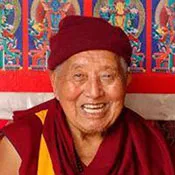
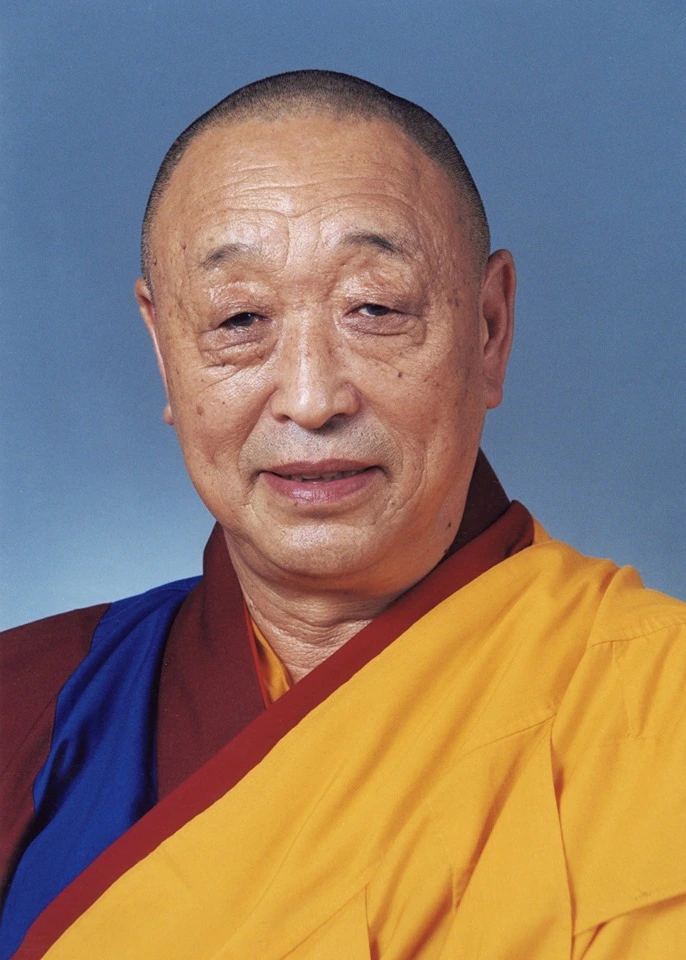
His Holiness the 33rd Menri Trizin Lungtok Tenpai Nyima Rinpoche
His Holiness the 33rd Gyalwa Menri Trizin, Lungtok Tenpai Nyima Palzangpo Rinpoche, was one of the greatest modern masters and preservers of the Yungdrung Bön tradition. Revered as the crown ornament of Bön and the chief teacher of the White Hat tradition, he dedicated his entire life to preserving, restoring, and spreading the teachings of Bön throughout the world.
He was born on the fifteenth day of the fifth month of the Earth Snake year in 1929 in lower Amdo, in the region of Sharkhok, into the Jongdong family. His father was Jongdong Gyalo and his mother was Barongza Tsomo. From an early age, Rinpoche demonstrated extraordinary intelligence, devotion, and discipline.
At the age of seven, he entered Kyongtshang Monastery where he first learned reading, prayer recitation, ritual practice, and daily liturgies. By the age of thirteen, he had become highly skilled in chanting, melodies, ritual instruments, horns, drums, and cymbals.
At Nangzhig Monastery in Amdo, he received ngöndro teachings from the master Sherab Tendzin and completed the preliminary practices three times. Later, at Gamal Monastery, the master Sherab Phuntshog gave him the name Sherab Tshulthrim after experiencing auspicious dreams and signs connected with the young practitioner.
At seventeen, during the celebration of Nyamed Sherab Gyaltsen’s birthday, he received novice monk vows in the presence of Kyong Tshang Lama Sherab Tenpai Gyaltsen and received the name Sherab Namdak. Under the guidance of the venerable Horwa lineage master Drungrampa Tendzin Lotro Gyasto, he extensively studied grammar, poetry, astrology, astronomy, philosophy, logic, the stages of the path, paramitas, and many branches of traditional Bön scholarship.
At the age of twenty-five, after successfully completing examinations on the six major philosophical treatises of Yungdrung Bön, he earned the highest academic degree of Geshe. He later traveled to Gyalrong where he arranged for the printing of two copies of the Bön Canon from woodblocks, offering them to Kyongtshang Monastery. He also acquired many sacred scriptures and texts in honor of his parents and placed them within his family shrine room.
At twenty-eight, he received numerous empowerments and transmissions from Alak Nangsel Namkha Gyaltshen. He then traveled to Yungdrung Ling Monastery where he received novice monk vows according to that lineage’s tradition and was given the name Sangye Tendzin. Later, at Tashi Menri Monastery, he met the 30th Menri Trizin, Tenpa Lodro, and received important transmissions of the Zhang Zhung Nyengyud cycles.
Rinpoche also studied at the Geluk Drepung Gomang Monastery, where he trained in Buddhist philosophy, logic, paramitas, and debate under renowned scholars, deepening his understanding through rigorous scriptural study and reasoning.
At the age of thirty-one, during the Tibetan uprising, he escaped into exile to Nepal along with his retinue. During this difficult period, he visited numerous Bön monasteries, received many transmissions and empowerments, and safeguarded precious Bön scriptures by arranging their reprinting in Delhi. These texts were later distributed to libraries and universities throughout the world.
At the age of thirty-three, he was invited by Professor David Snellgrove to teach Tibetan language and Bön culture at the University of London. During his three years in England, he also learned English and met Pope John Paul VI, with whom he discussed shared spiritual and religious values.
In 1960, he returned to India and was appointed by His Holiness the 14th Dalai Lama as a teacher in the first school established for Tibetan exiles in Mussoorie.
In 1967, at the invitation of Professor Per Kvaerne, he conducted research and teaching at the University of Oslo in Norway.
In 1968, at Dolanji, following requests from senior Bön masters and monasteries, a great assembly was held to determine the next Menri Trizin. Through sacred signs, protector prophecies, and traditional methods, Sangye Tendzin was recognized and enthroned as the 33rd Menri Trizin, holder of the throne of Menri established by the second Buddha, Nyamed Sherab Gyaltsen. Upon enthronement, he received the name Lungtok Tenpai Nyima Palzangpo.
Together with Yongdzin Tenzin Namdak Rinpoche, he rebuilt and re-established the Bön tradition in exile. In 1970, they founded Palshenten Menri Ling Monastery in Dolanji, India, restoring the authentic traditions, rituals, education, and practices of Menri Monastery.
Over the following decades, His Holiness established numerous important institutions and projects, including:
- The Central School for Tibetans in Dolanji (1975)
- The Yungdrung Bön Dialectic School (1978)
- The Yungdrung Bön Department at the Central Institute of Higher Tibetan Studies in Varanasi (1987)
- The Bön Children’s Home (1988)
- Redna Menling Nunnery (2001)
- Sang Ngag Gomdrub Ling practice center (2005)
- The Yungdrung Bön Library at Menri Ling (2007)
- The Yungdrung Bön official website initiative (2011)
- The Sorig Bumzhi Medical School at Menri Ling (2014)
In 1988, His Holiness invited His Holiness the 14th Dalai Lama to Menri Monastery. The Dalai Lama personally reviewed the educational standards of the Bön Dialectic School and praised the quality and completeness of its training, later agreeing to recognize and sign Geshe degrees.
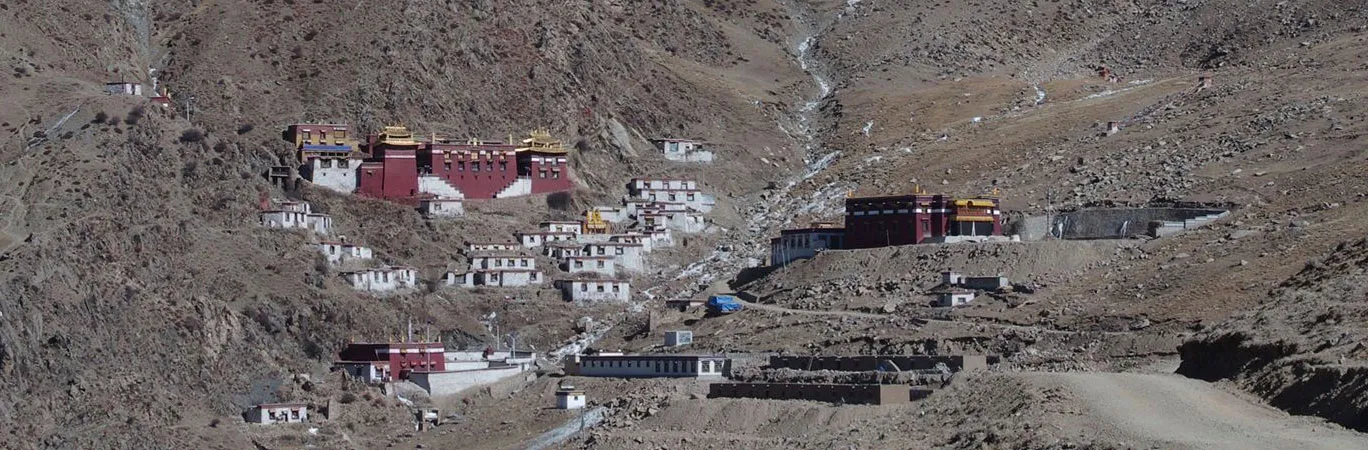
In 1994, His Holiness made his first return visit to Tibet and sat upon the golden throne of Nyamed Sherab Gyaltsen at Tashi Menri Ling.
Throughout his life, the 33rd Menri Trizin tirelessly worked to preserve the teachings of Sutra, Tantra, Dzogchen, monastic discipline, ritual traditions, education, medicine, and culture of Yungdrung Bön. Thousands of monks, nuns, scholars, and lay practitioners benefited from his guidance, compassion, and wisdom.
In 2017, at the age of 89, on September 14 at 6:25 in the evening, at his residence in Palshenten Menri Ling, His Holiness entered the sublime state of Thugdam — meditative absorption into the expanse of reality. In the days before his passing, he personally met with students, local Tibetan communities, lamas, monks, and Geshes, offering blessings and final guidance.
His Holiness Lungtok Tenpai Nyima Rinpoche remains one of the most important spiritual figures in the modern history of Yungdrung Bön, remembered for his profound scholarship, humility, compassion, and unwavering dedication to preserving the teachings for future generations.